ANIME FIELD NOTES
One Piece
Luffy wants to find the One Piece and become King of the Pirates. Getting there means finding people who can do what he can't: navigate, cook, treat injuries and keep a ship afloat. Each island adds trouble, but the crew's separate dreams keep the voyage moving.
What to notice
A straw hat is an easy clue. Sorting out the crew takes more: Nami navigates, Sanji cooks and Chopper treats the injured. When two answers seem plausible, check whether the prompt describes someone's job, dream or Devil Fruit ability.
In this guide
The crew is a better starting point than the bounty list
One Piece introduces enough names that memorizing them in isolation soon stops helping. Start aboard the ship. Luffy is captain, Nami navigates, Sanji cooks, Chopper is the doctor and Robin is the archaeologist. Those jobs tell you what each person contributes when a new island presents a problem. A clue about maps should lead you toward navigation; a clue about reading lost history belongs somewhere else.
The interesting part is how a job connects to a dream. Luffy's wish to become Pirate King doesn't make him the crew's best navigator or swordsman. A good identification question uses two details together. Try covering the answer choices and naming both the role and the ambition before looking at the options.
How to tell a useful visual clue from decoration
A silhouette removes facial expressions and color. Look first at the whole outline: the hat, the proportions, the shape of a weapon and the way clothing changes the figure. A straw hat is recognizable, but a hat alone is a weaker clue than the combination of headwear and stance. In text questions, the same principle applies: one familiar trait may fit several people; the combination usually matters.
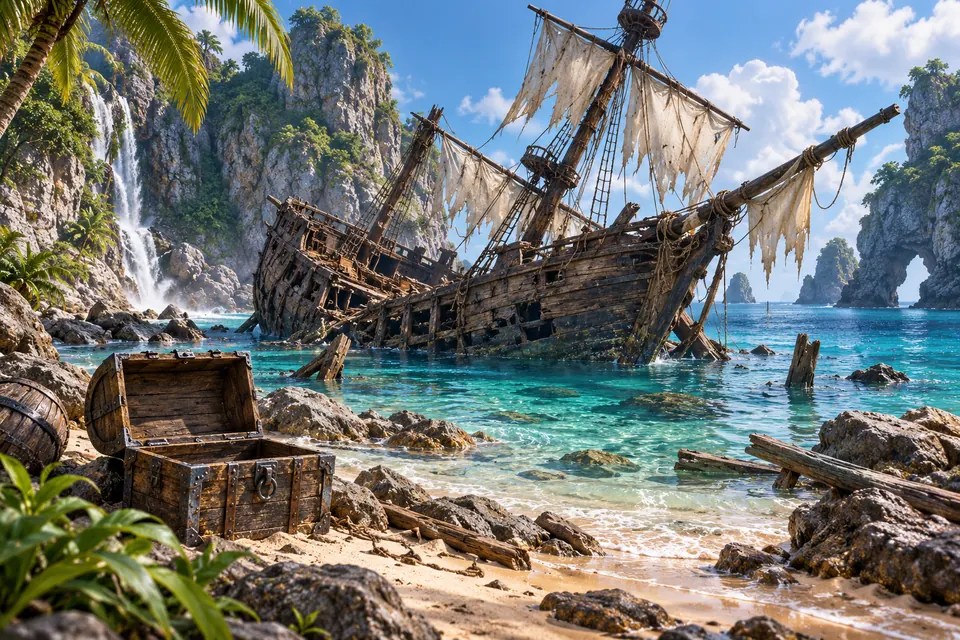
The scenery on this page is an original pirate-themed illustration. It sets a mood without pretending to be a frame from the show. It cannot tell you which studio animated One Piece or how that studio draws movement. Treat the studio credit as a separate production fact.
Why the island and objective change a battle question
The opening East Blue stories introduce a crew through individual problems. Later settings, including Water Seven, ask more of the crew as a group. That change matters when comparing scenes: rescue, escape and an outright knockout are different objectives. A person can lose a fight while helping the crew accomplish its mission.
When a prompt names an island or encounter, keep that setting attached to the result. A statement that someone wins a particular confrontation doesn't settle who is strongest across the whole series. If a question leaves the objective unclear, use the report control rather than trying to infer an unstated power ranking.
A three-step review after a wrong answer
Write down the two characters you mixed up. Then give each a different anchor: Nami—navigation; Robin—archaeology, for example. Finally, return to the wording and identify the detail that excludes your first choice. This makes the correction something you can use in a new question, instead of another name to recognize in the same sentence.
For a technique question, separate the fighter from the attack. For a production question, separate the manga creator, animation studio and distributor. The worked examples below show how these different categories can appear beside one another without being interchangeable.
Names worth keeping apart
| Name or concept | Useful clue | Watch for |
|---|---|---|
| Nami | Navigator; maps and routes | Robin's archaeology concerns lost history. |
| Nico Robin | Archaeologist; historical knowledge | Navigation clues point toward Nami. |
| Sanji | Cook; fighting with kicks | Zoro's characteristic clue is three swords. |
| Tony Tony Chopper | Doctor and reindeer | The medical role and identity work together. |
Keep these straight
- Separate a character's dream from their job on the crew.
- A Devil Fruit ability and a fighting technique are different kinds of answer.
- Read the island or arc before choosing the winner of a battle.
Test yourself
There are 81 related questions in the current game. The examples below may contain story spoilers. Try an answer before expanding its explanation.
Wants to become King of the Pirates, and his body stretches like rubber. One Piece
ANSWER
Monkey D. Luffy
Luffy is the Straw Hat captain; Zoro is the swordsman, Sanji the cook and Nami the navigator. The ambition to become Pirate King identifies Luffy's goal, while the stretching clue identifies his ability. Keeping those two clues together rules out the other crewmates.
Swordsman who fights with three swords and gets lost constantly. One Piece
ANSWER
Roronoa Zoro
Three-sword fighting is the useful distinction here. Luffy leads the crew, but Zoro is its swordsman. Sanji's close-range fighting can make him a tempting choice; his characteristic attacks use his legs rather than three swords.
Which studio animates One Piece? One Piece
ANSWER
Toei Animation
Toei Animation is the animation-production answer for the version named here. A studio credit identifies the animation team, not the source author or the streaming service. Check the season or year before applying that credit to another adaptation.
Luffy's basic stretching punch. One Piece
ANSWER
Gum-Gum Pistol
Gum-Gum Pistol is the name that matches the ability described in the prompt. Link a technique to its user and defining effect; a character, a transformation and an organization can appear together without being the same kind of answer.
Sources & corrections
Check the linked series and production pages for context. Studio credits apply to the adaptation named in the question. If a battle result seems ambiguous, send us the scene or source that explains why.
Found an ambiguous question? Use Report question in match results, or send a correction with the prompt and the relevant source.